How to Get Rid of Static Hair in Winter
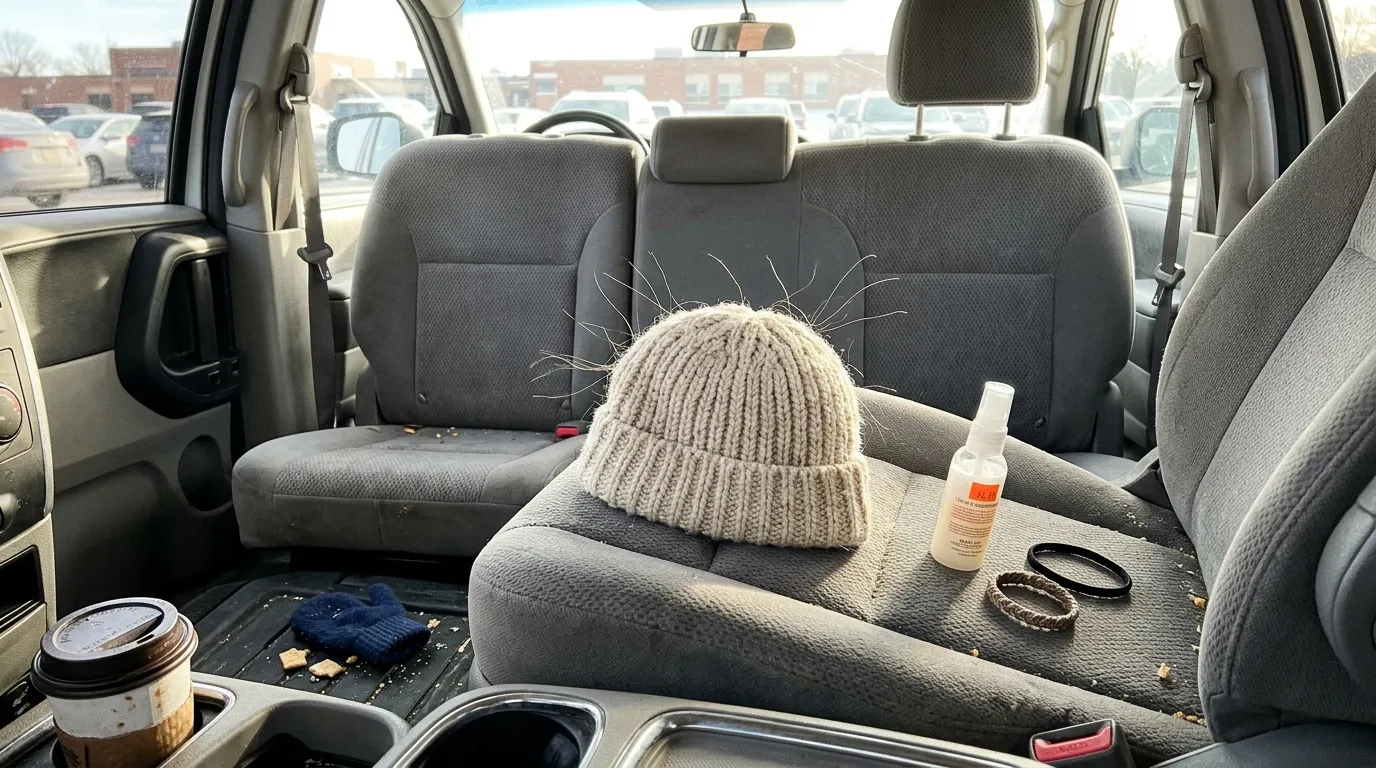
Static is a physics problem you solve in a minivan at 8:04 a.m. The furnace strips the moisture out of the house, the beanie rubs electrons off your strands on the drive, and by the time you’re unbuckling kids, your hair is standing up like it’s trying to leave your head. You have maybe ninety seconds before the school door. Here’s what actually works in that window, and the one habit that keeps it from happening tomorrow.
Why does my hair have static when it’s this cold?
Friction, plus dry air. Every strand carries a tiny electrical charge, and when hair rubs against wool, polyester, or a car-seat headrest, electrons transfer between the surfaces. Once the strands all carry the same charge, they repel each other, and gravity loses (Science Behind Life). Water normally gives that charge an escape route. Winter air, indoors and out, holds almost none, so the charge just sits there (SELF). That’s also why fine hair suffers most: thin, lightweight strands lift easily, while thick hair weighs the same charge down.
Which means the fix is either moisture, charge-neutralizing ingredients, or less friction. Preferably all three before February.
The 60-second static hair fix for the drop-off line
- Wet your fingertips and smooth them over the flyaways. Water restores the charge balance on the spot. It’s the fastest fix that costs nothing, and it works through a hat (Healthline).
- Rub a tiny dot of lotion between your palms, then pat the halo down. Face moisturizer, hand cream, whatever’s in the cupholder. The lubricant plus a little moisture calms the charge.
- Spray leave-in conditioner into your palms, then finger it through. Stylist Deycke Heidorn’s exact move for on-the-go static: the moisture in the product eliminates the charge (SELF). Spraying your palms first keeps fine hair from going limp.
- Flip your part to the other side before the hat goes back on. When you take the hat off and flip back, you get volume and no static in the same move (SELF).
The dryer-sheet myth, sorted
You’ve seen this one: rub a dryer sheet on your hair. It does work, mechanically. Fabric softeners are positively charged, and they neutralize the negative charge built up on your strands (Healthline). Stylists also use them; one celeb stylist keeps a box in her kit for exactly this (Good Housekeeping).
The myth part is the everyday laundry sheet. Stylists mostly advise against them because they’re formulated for fabric, and the fragrance and residue can irritate a dry winter scalp (SELF). The upgraded version: sheets made for hair, coated in polymers and a little oil instead of laundry softener. Nunzio Saviano Anti-Frizz Sheets run about $12 on Amazon; Nexxus makes one too (SELF). One packet lives in the glovebox now. Swipe it along the hairline and the crown, skip the roots.
The prevention habit: leave-in, then less friction
The two-minute move at home beats every car-line rescue. Leave-in conditioner on damp hair, every morning of hat season: stylists recommend it daily, and the cationic, positively charged ingredients in conditioner are literally designed to neutralize static charge and press the cuticle flat (SELF, PMC). It’s the same reason a metal comb beats plastic; metal conducts the charge away instead of building it (Healthline).
Then cut the friction where you can. Hats lined in silk or satin generate far less charge than acrylic or polyester (Good Housekeeping). A humidifier set between 40 and 50 percent gives the charge somewhere to go all day (Why Is My). And if you blow dry, an ionic dryer presses everything flatter than a regular one (Good Housekeeping). The leave-in is the daily habit; the humidifier is the house fix. For the full winter product swap, the seasonal hair care rotation covers what to change every three months, and how often you should wash your hair matters here too, since every extra shampoo strips the oils that keep charge from building. Pair the leave-in with a heat protectant on blowout days and you’re covered from both directions.
If you only do one thing: put leave-in conditioner on damp hair tomorrow morning, before the hat. That’s the whole prevention plan, and it fits inside the time it takes to find the other mitten.