How to Repair Nails After Gel or Dip: 6-Week Plan
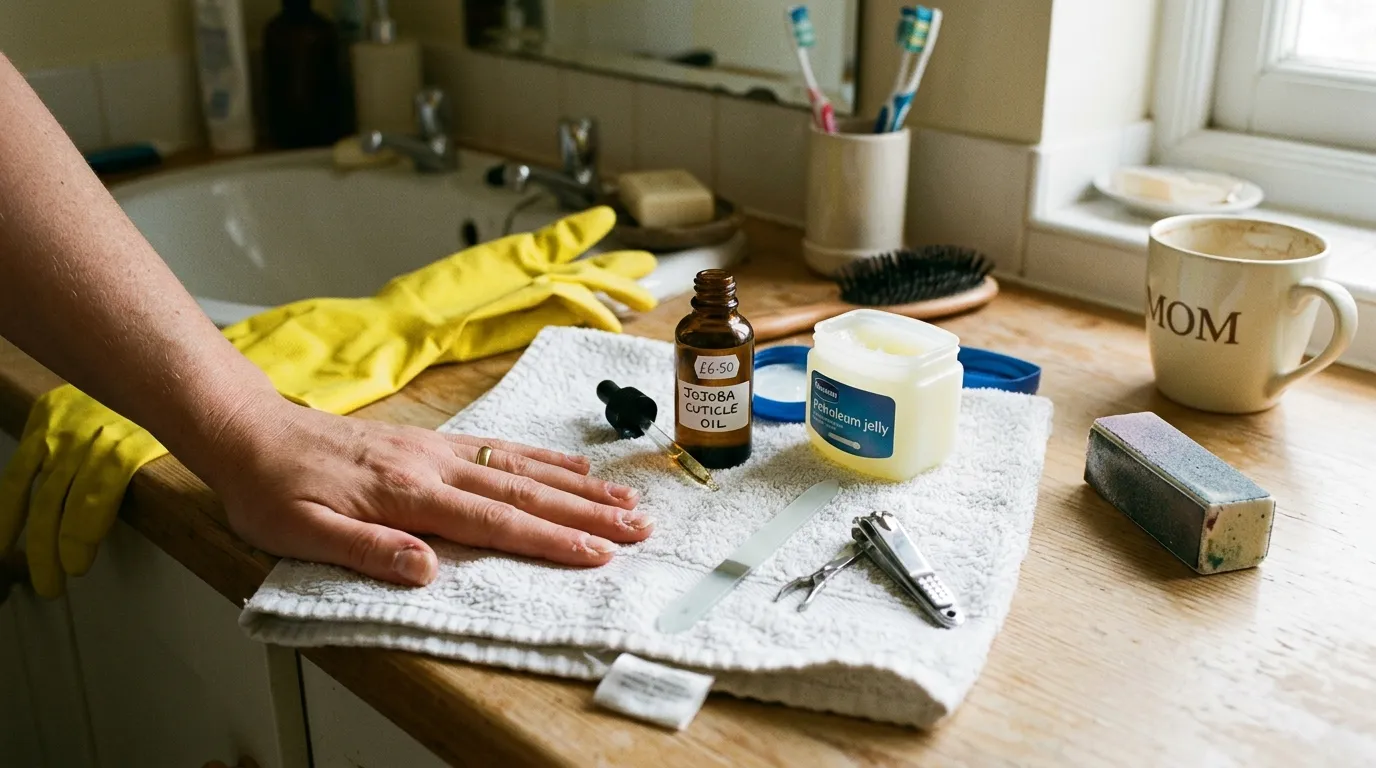
The gel came off two weeks ago and your nails still feel like wet cardboard. Thin in a way you can hear when you tap them on the counter, peeling in translucent layers at the tips, snagging on towels and toddler socks. This is the standard aftermath of a soak-off manicure, and it has a standard fix. What follows is a six-week plan for how to repair nails after gel or dip: what to do each week, what it costs (about $10 total), and which strengthening products have real evidence behind them.
For moms, this repair window collides with the most nail-hostile job description there is. Dishes, bath time, handwashing on a loop. The obvious escape, booking another gel set to hide the damage, is the one dermatologists warn against: the American Academy of Dermatology notes that covering brittle or damaged nails with artificial ones can make existing problems worse (AAD). The plan below assumes no appointments and hands that are wet most of the day. That’s the actual constraint, so that’s the actual plan.
Why Your Nails Feel Thin After Removal
Two things happened at removal, and the polish itself was innocent. To make gel or acrylic adhere, the nail tech files the surface of your plate until it feels rough, and the AAD is blunt about what that does: filing thins natural nails and makes them weaker (AAD). Dermatologists have a name for the extreme version, worn-down nail syndrome: visible thinning of the plate from over-filing, documented after acrylic removal (Skin Appendage Disorders review).
Then came the acetone. Gel soaks off under 100% acetone wraps for 10 to 15 minutes (same review), and dip powder takes longer, 15 to 20 minutes, because the coating is thicker (our own durability comparison). Acetone dissolves the oils that keep a plate flexible. A flexible plate bends. A stripped one snaps and peels.
Here’s the most useful reframe in this whole plan: the visible nail can’t heal, because it’s dead keratin. Nothing you buy regrows it. The next six weeks protect the damaged plate while new, undamaged nail grows in behind it. That’s why oiling helps (it conditions the plate you have) and why patience matters more (only growth removes the thin part).
Nails Peeling After Gel: Weeks One and Two
The first two weeks come down to two moves: keep water off, put oil on.
Take a full polish holiday. The AAD recommends one to two weeks or longer with nothing on the nails so they can recover (AAD). No clear coats, no “breathable” formulas, no sticker nails. Two weeks of nothing is the cheapest treatment on this list.
Oil twice a day. Any cuticle oil works; jojoba runs about $9 at Target, and plain petroleum jelly, the AAD’s own suggestion, does nearly the same job (same page). Massage it into the plate and cuticle after every hand wash and before bed. The plate lost its oils to acetone; this is the only way to put them back.
The buffer goes in the drawer. This is the hardest rule, because peeling edges look fixable with a quick buff. They aren’t. Buffing shaves thickness off a plate that is already too thin, and at roughly 3.5 mm of new growth per month (Yaemsiri et al., 2010), you can’t afford to spend any of it on smoothing. If an edge snags, clip the loose layer with a clipper and file once, in one direction, with a glass file. Leave the surface blotchy. It grows out.
Keep nails short. Short nails with slightly rounded tips are the strongest configuration (AAD). Length is leverage; a short nail has nothing to catch and peel back. Set the clipper limit at the fingertip for six weeks.
Gloves are the whole secret. The AAD names too much water as a direct cause of splitting and peeling (same page). During the weakest month, dishes and scrubbing happen in rubber gloves, and bath time ends with a towel-dry and another pass of oil. Four extra seconds each time.
Nail Recovery After Dip Powder: Weeks Three Through Six
The routine barely changes. The calendar is the point. Dip powder sits thicker on the nail and soaks off slower, so the plate underneath usually takes the worst of it, which is exactly why the no-soak-off-services rule runs the full six weeks. (People searching for nail recovery after dip powder tend to relapse around week four, when the grow-out gap looks embarrassing. It isn’t. It’s progress.)
If you need color by week three, traditional polish only, ideally over a base coat, removed with one quick acetone pass or a non-acetone remover. That’s the entire acceptable menu. No gel, no dip, no acrylic, and no drill anywhere near your plate.
For an event, press-ons with adhesive tabs are the safe splurge: they press on without filing and float off the next morning. Glue versions need roughing up the plate and solvent to remove, so save those for after recovery. Our press-on guide for moms covers which sets survive what.
By week six the math starts working for you. At 3.47 mm a month, six weeks of growth is about 5 mm of new nail, which carries most plates past the buffed zone. If nails still peel at week six, the usual suspects are an aggressive removal, someone used a drill, or a house habit, wet hands with no gloves. Both are fixable in round two.
Strengthen Nails After Acrylics: Evidence Versus Marketing
The strengthening aisle is where recovery budgets go to die. Here’s the honest sorting:
| Product | What it promises | What the evidence says |
|---|---|---|
| Cuticle oil, jojoba, petroleum jelly | Flexible, less brittle nails | The one step dermatologists recommend by name; the AAD advises moisturizing several times daily between manicures. Under $10. |
| Formaldehyde “nail hardeners” | Hard nails in days | They cross-link the plate surface, which reads as harder, but the tosylamide/formaldehyde resin in many is a documented allergen, with reported reactions from dermatitis to onycholysis, the nail lifting off its bed (review). Skip on damaged nails. |
| Biotin | Faster, stronger growth | Total published support for nails: three case reports, in people with brittle nail syndrome, at 2,500 to 3,000 mcg a day (review). No trials in healthy people. It can’t rebuild a filed plate. |
| Keratin “rebuilder” polishes | Repairs the nail | It’s a coating. Fine as a base coat; the word “repair” is doing marketing work. |
| Gel strengthener overlays | Protection while you grow out | A second soak-off cycle in disguise. Worst item on the shelf for this job. |
Biotin gets the longer treatment in our hair vitamin investigation; the short version is that the 5,000-mcg gummies in the checkout aisle solve a deficiency you almost certainly don’t have. Already take biotin? Fine. Buying it for this? Put the $14 in the cuticle oil fund instead.
How Long Nails Recover After Gel, Realistically
Fingernails grow an average of 3.47 mm per month (Yaemsiri et al., 2010), so how long nails recover after gel comes down to arithmetic. Six weeks buys you about 5 mm of new nail, enough that the thinned zone is mostly grown out or clipped away on a short nail. A completely fresh plate takes closer to three to four months at that rate. Six weeks is when nails are functional again. Four months is when they’re fully yours.
One caveat beats all the routines: pain, swelling, green or black discoloration, or a nail lifting from the bed that keeps spreading are dermatologist territory. Green in particular suggests a bacterial infection taking advantage of a lifted plate (review), and it needs actual treatment, not oil.
So, ranked: start with what costs nothing, gloves on, nails short, buffer in the drawer. Add the $9 oil and use it more often than feels reasonable. Keep polish traditional until the six-week mark. Skip formaldehyde hardeners and gel overlays entirely. Six weeks of boring beats another soak-off cycle, and time is the one repair product that always works on schedule.