Scalp Care Routine for Healthy Hair (7 Days a Week)
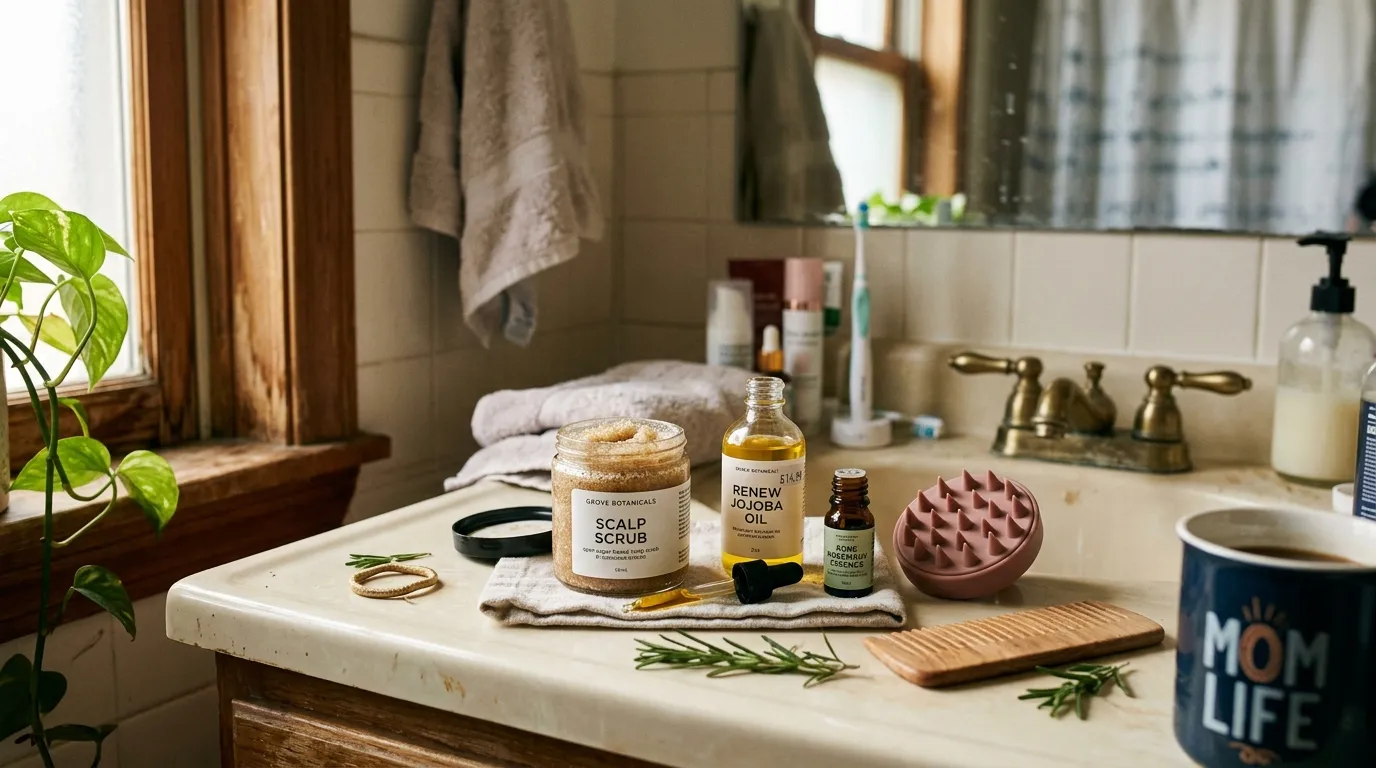
Roughly 17% to 50% of the general population deals with dandruff, according to a 2025 review in the Journal of Cutaneous Medicine and Surgery. My stylist sees a milder version of that number every week: the parting at the back of the head, the quiet flake storm, the “I swear I wash it” that arrives right before the itch confession. A scalp care routine for healthy hair gets skipped because it feels optional. It’s the skin your hair grows out of. The whole plan is three habits on a seven-day loop: exfoliate once a week, oil before a wash, massage every day.
Why the Stylist Chair Tells the Truth
Flakes, itch, and a tight feeling at the roots are the three complaints that show up in the chair, usually in that order. What they have in common is buildup: dead skin cells the scalp shed, like the rest of your skin, plus sebum, plus whatever dry shampoo, leave-in, and heat spray you’ve layered on since your last real wash.
The scalp holds more product and oil than any other patch of skin you own, and it gets cleaned less often. If you’ve been stretching your washes to every third or fourth day, which is the right call for a lot of hair types, the residue has more time to pile up. That’s the case I made in how often you should wash your hair. This routine is the other half: what you do in the space between washes.
Scalp Exfoliation at Home: The Once-a-Week Rule
Scalp exfoliation at home is the step most people get wrong in both directions. Some never do it. Others scrub like they’re scouring a pan and end up with a raw, over-oily scalp.
The guardrail is frequency. Healthline’s reviewed guidance is that daily scalp massage is fine, but exfoliation should top out at once or twice a week. Exfoliation strips oil, and strip it too often and the scalp overproduces to compensate. Over-exfoliated scalps flake more, not less. That’s the myth worth busting: your flakes are often the result of too much scrubbing, not too little.
The at-home version costs almost nothing. On wet, shampooed hair, part it into sections and press a scrub in with your fingertips in slow circles for two or three minutes. A DIY mix of two tablespoons brown sugar, two tablespoons finely ground oatmeal, and two tablespoons of conditioner works as well as anything in a jar. If you’d rather buy it, a drugstore scrub runs $8 to $14 and lasts months.
Skip exfoliation entirely if you have an active infection, open sores, or a diagnosed scalp condition like psoriasis. That’s a dermatologist conversation, not a scrub conversation.
The Best Oils for Scalp Health (and the One to Skip)
Oiling the scalp is not moisturizing in the lotion sense. It’s about adding oils that behave like the ones your skin already makes, or that calm the yeast and flaking that cause dandruff. Not every oil does the same job.
- Jojoba. It’s a liquid wax ester, chemically the closest plant oil to human sebum, and it has a long history of traditional use for scalp complaints, per a review in Polymers. A small 2012 study reported in Cosmetics & Toiletries had 20 women apply it twice a day for 28 days; sebum output dropped 23%. For a dry, flaky scalp, it’s the gentlest starting point, around $10 to $15 a bottle.
- Rosemary. The 2015 randomized trial by Panahi and colleagues put 100 people with androgenetic alopecia on either rosemary oil or minoxidil 2%, twice a day for six months. Hair count rose in both groups by month six, and scalp itching was more common in the minoxidil group. Use it diluted in a carrier oil, and plan for months, not weeks.
- Tea tree. The classic 2002 study used a 5% tea tree shampoo on 126 people with moderate dandruff for four weeks: 41% improvement versus 11% for placebo. Keep tea tree in a shampoo or heavily diluted. Neat on the scalp, it irritates.
- Coconut. A 2005 study in the Journal of Cosmetic Science found coconut oil penetrates the hair fiber while mineral oil just sits on the surface. That makes it better for dry lengths and ends than for a fine, buildup-prone scalp.
| Oil | What the research says | Best for | Typical price |
|---|---|---|---|
| Jojoba | Closest plant oil to sebum; 23% less sebum in a 28-day study | Dry, flaky scalps | $10-15 |
| Rosemary | Matched minoxidil 2% hair count at 6 months, less itching | Thinning, slow growth | $12-20 diluted |
| Tea tree | 41% vs 11% dandruff improvement in 4 weeks | Itchy, flaky scalps | $8-12 (in shampoo) |
| Coconut | Penetrates the hair fiber | Dry lengths and ends | $5-8 |
The one to skip: leaving a heavy oil on overnight if you have fine hair or a scalp that builds up fast. Overnight oiling is the internet’s favorite scalp trend, and it’s the fastest route to greasy roots and clogged follicles for anyone who doesn’t need that much slip.
Scalp Massage Benefits for Hair Growth: What the Research Says
The best evidence for massage is a 2016 study in Eplasty. Nine men did four minutes of standardized scalp massage daily for 24 weeks. Hair thickness increased from 0.085 mm to 0.092 mm. Small sample, all men, and it moved thickness, not density, so treat it as promising rather than proven. Four minutes a day is also roughly one song, which is a time commitment that survives a Tuesday.
Massage costs nothing, takes minutes, and is safe daily. Do it with dry hair, or fold it into wash day by massaging while conditioner sits. The scalp is skin, and like all skin it responds to circulation and to being touched without being yanked.
Dry Scalp Remedies for Women: Flakes vs. Dandruff
Before you buy anything, know which flake you’re fighting. They get treated differently.
Dry scalp flakes are small, dry, and white, and they come with a tight feeling. They spike in winter, when indoor heat and cold air strip moisture, which is exactly when my seasonal hair care rotation matters most. Dandruff flakes are larger and greasier, sometimes yellowish, and they itch. Dandruff is driven by Malassezia yeast, which is why the fix is an antifungal shampoo, zinc pyrithione, or tea tree, not more moisture.
Dry scalp remedies for women who actually have dry scalp: wash with lukewarm water instead of hot, keep shampoo off the ends, run a humidifier in the bedroom, and work jojoba into the scalp thirty minutes before a wash. If flakes come with redness, bleeding, or patches that spread, or if a month of consistent care changes nothing, see a dermatologist.
One more thing to file under scalp anxiety: it’s normal to shed 50 to 100 hairs a day. If you’re postpartum and the number feels higher, that’s a specific, time-boxed process with its own timeline and treatment options.
The 7-Day Schedule
Here’s the whole week. No morning for it, no 10-step anything.
| When | What to do | How long |
|---|---|---|
| Daily | Scalp massage, dry or in the shower | 4 minutes |
| 2-3x weekly | Jojoba or diluted rosemary on the scalp, 30 minutes before a wash | 30 minutes |
| Weekly | Exfoliate, then oil, then wash, in that order | 15 minutes |
| Monthly | Clarifying shampoo to reset buildup | 5 minutes |
If you only have one habit in you, take the daily massage. If you have a Sunday night, run the full loop: exfoliate, let jojoba sit for half an hour, wash it out. Wash after oiling. Letting oil sit on unwashed scalp for days is how buildup starts.
Start With the Massage
Ranked, in case you skimmed: start with the four-minute daily massage, because it’s free and you’ll feel the difference at the roots inside two weeks. Add jojoba or diluted rosemary on the night before a wash. Exfoliate once a week and refuse the urge to do it more. Skip overnight oiling and anything that promises faster results.
Give it a month. The scalp turns over slowly, and the payoff shows up in hair that sits shinier and falls less flat. That’s the version of scalp care that survives a real week.