I Tried a Silk Pillowcase for 30 Nights: The Real Verdict
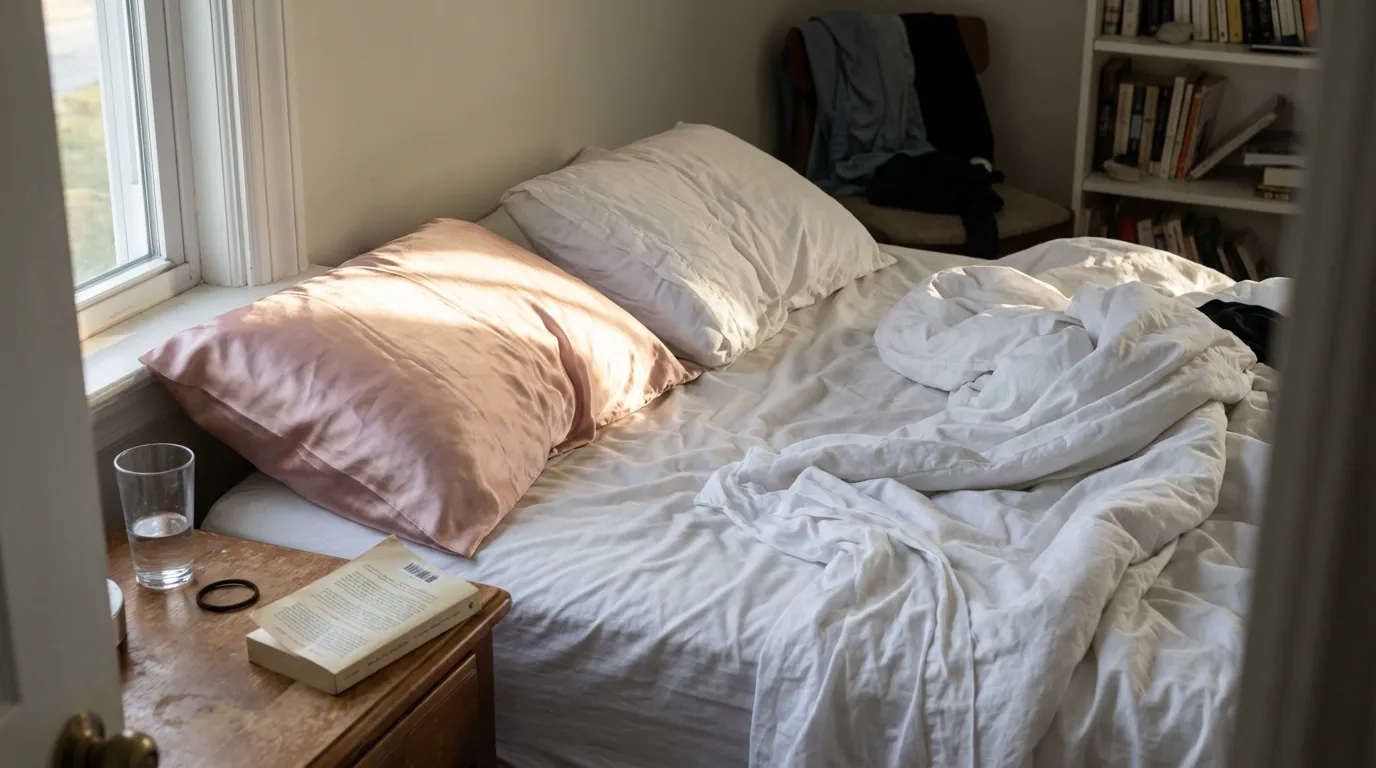
The first night I slept on a silk pillowcase, I woke up at 2 a.m. convinced it had slid off the bed. It had not. My face had just skated across it in a way I had never felt before, like a slice of bread launched off a countertop. I had bought the thing on a whim for $24.99. I set a reminder in my phone. Thirty nights, then decide.
I am a skeptic about bedroom-sized miracles. If something works for me, it has to survive two kids and a laundry pile that eats product reviews for breakfast.
What the Research Actually Says About Silk vs Cotton
Before buying anything, I went looking for a number I could trust. A study referenced across the dermatology press reports silk produces roughly 43 percent less friction against hair than cotton, published in the Journal of Cosmetic Dermatology. Cotton fibers, under a microscope, look like a cactus. Silk looks like a frozen pond. Your hair cuticle is soft protein, and it knows the difference.
The other real difference is water. Cotton is a sponge. Silk retains about 97 percent of its moisture through the night, compared to roughly 75 percent for cotton. Your face cream, scalp oils, and the water you drank at 9 p.m. all stay on your face instead of wicking into the pillow.
The caveat: most of this research is small or industry-adjacent. Dermatologists call it “suggestive, not conclusive.” But the friction number is physics.
What 22 Momme Mulberry Silk Actually Feels Like
By night 11, I returned the $24.99 pillowcase and bought a real 22 momme mulberry silk one for $42.
Momme is how silk is weighed: pounds per 100 yards of standard-width fabric. Per Mayfairsilk’s fabric guide, 22 momme contains about 16 percent more silk than the entry-level 19 momme. Below 19 is usually too thin to survive a washer with kid laundry.
What to look for on the label:
- 22 momme minimum. 19 is okay for a trial. 22 lasts longer.
- 6A grade mulberry silk. Top grade for fiber length and uniformity.
- Hidden zipper or envelope closure. Elastic edges bunch and pill.
$42 is roughly the honest minimum tested buyer guides land on. Under $25 is almost certainly not 100 percent mulberry silk. Over $80 for one case is someone’s marketing budget. Quince and Mulberry Park Silks are the best price-to-quality I have found. No affiliate links.
Does a Silk Pillowcase Reduce Hair Breakage
By night 20, something was working. The short, broken strands that usually lived around my hairline were thinning out. Not gone. Thinner. I ran my hand along my scalp and felt fewer of those stiff stubs that signal mechanical breakage.
Night 8 was the tell. I went to bed with damp hair, which I usually avoid because wet hair is weaker and cotton friction is worst on damp strands. In the morning: no tangles at the nape, no broken baby hairs on the pillow. For anyone dealing with postpartum shedding or fragile regrowth, this alone is the pitch.
A silk pillowcase does not regrow hair. It reduces the friction that creates new breakage. Insurance, not a cure. $42 is easy math.
The Skin Thing Nobody Talks About Correctly
Night 18, I noticed the crease. Or rather, its absence. I am a right-side sleeper, and for two years I had a faint vertical line from the corner of my mouth to my chin that did not fully fade until I had been vertical for an hour. I had started to think of it as permanent.
A 2016 paper in Aesthetic Surgery Journal on sleep wrinkles calls these “sleep lines.” The authors found they form when skin is compressed and distorted against a surface night after night, and over time they get etched in.
On silk, my face did not compress. It slid. By night 28 the crease was almost gone in the morning and back to normal within twenty minutes of waking. A sample size of one is not science, but a line that had bothered me for two years got measurably better without any other change to my routine.
Your skin repairs on a circadian schedule, and a silk pillowcase on three hours of sleep is not going to do much. Get the pillowcase and get the sleep.
Washing a Silk Pillowcase Without Ruining It
This is where most silk pillowcase experiments die. People throw them in a hot wash with towels and the thing comes out the texture of a crumpled receipt.
The rules: cold water, delicate cycle, mesh laundry bag, mild enzyme-free detergent, no bleach, no fabric softener, no dryer. The Sleep Foundation’s care guide covers it. Hang dry or lay flat on a towel. Mine has been through twelve machine washes and still feels like the day I bought it.
The 30-Night Verdict
I am keeping it. I bought a second one. What actually changed, measured honestly:
- Hair: Less breakage. Topknots held better overnight.
- Skin: A sleep crease I had written off as permanent mostly faded.
- Face cream: Products stayed on my face instead of the pillow.
- Frizz: Fine hair ran smoother by day two.
- What did not change: Acne. Hydration. A pillowcase is not a serum.
For $42 you are buying the one piece of your routine that works while you sleep and requires zero effort. Almost nothing else in the cabinet has that profile. You will not wake up a different person. You will wake up with the small daily damage you were doing to yourself quietly not happening. I wish I had bought one five years ago. That is the real lesson.