Wet to Dry Hair Straightener: My 30-Day Mom Test
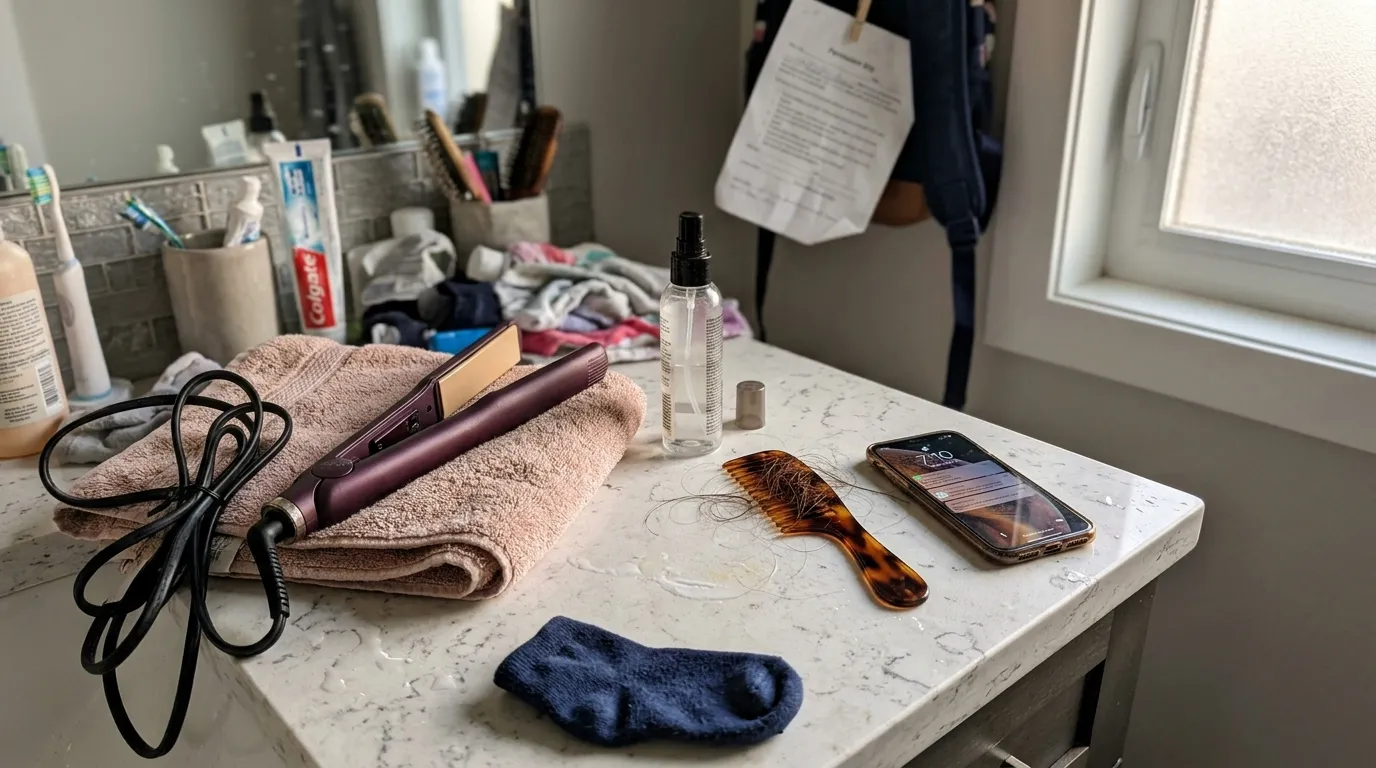
7:12 a.m. on a Tuesday, hair dripping down my back, one kid asking where his other sock is, the other already in the car. I had thirty-three minutes until the first bell and a $249.99 wet-to-dry straightener on the counter. I also had a stopwatch app and thirty school mornings to answer one question: does this thing actually replace a blow-dryer?
My hair is medium-thick, color-treated, and shoulder-blade length. The old routine took 33 minutes: rough dry, round brush, flat iron, cool shot. The new tool promised to collapse the drying and straightening into one pass. I timed both routines, checked my ends every Sunday, and kept notes.
Can You Straighten Wet Hair? The Answer Has a Catch
With a normal flat iron, no. Wet hair is fragile, and clamping water-filled strands between hot plates turns the water inside the shaft into steam. That is how bubble hair happens, a brittle breakage pattern linked to temperatures above 125°C (257°F) on wet hair (2022 review in Actas Dermo-Sifiliográficas). The American Academy of Dermatology says dry hair only, 347°F or lower, two or three times a week (AAD).
A wet-to-dry tool is built differently. It runs cooler and moves air through the section while the plates smooth. Dyson’s version uses unheated rods and airflow instead of clamping plates and runs cooler than a flat iron (Dyson); the Shark SilkiPro I tested uses heated plates with a sensor that reads temperature 1,000 times a second (Tom’s Guide).
The catch is the word “wet.” The instructions say towel-dried, not dripping. I tried it soaking wet once: 31 minutes and damp roots. Then I towel-dried, rough-dried the roots for two minutes, and the same routine took 19. The tool handled most of the drying. My roots still needed the blow-dryer.
Wet to Dry Flat Iron vs Blow Dryer: What the Stopwatch Said
I timed 22 school mornings, 11 on each routine, same heat protectant, same part, same hair.
| Step | Blow dry + iron | Wet-to-dry |
|---|---|---|
| Towel dry and protectant | 3 min | 3 min |
| Rough dry roots | 8 min | 2 min |
| Round-brush blowout | 13 min | 0 min |
| Comb and section | 0 min | 2 min |
| Straighten | 7 min | 14 min |
| Cool shot and finish | 2 min | 1 min |
| Total | 33 min | 22 min |
Average saving: 11 minutes. The best morning saved 15; the worst saved 4, on a rushed day with too much hair per clamp. The tool is slower per section than a flat iron because it is also drying. The minutes come from skipping the round-brush blowout.
Other testers saw the same range. A Business Insider reviewer went from 35 to 40 minutes to 15 with the Dyson version (Business Insider), while Cosmopolitan’s testers ranged from under 5 minutes on ultra-fine hair to 35 on fine straight hair used wet (Cosmopolitan). What varied was the hair and how wet it started.
The 30-Day Damage Check: What My Ends Said
Every Sunday I counted splits in a one-inch section behind my left ear and did a wet stretch test on the strands in my brush. Week one: six splits. Week two: six. Week three: eight, and the last inch felt rougher. Week four: nine, plus two white dots, counted on day 25. I had half an inch trimmed on day 26 and finished the test with clean ends.
No sizzle, no burnt smell, no patchy breakage at the crown. Four weeks is not a safety study. The tool lowered the heat and skipped a step; it did not make heat free.
I applied heat protectant to damp hair, combed it through, rough-dried the roots, kept the styler on medium, and stopped at two passes per section. The heat protectant I used all month is the same one I tested in September, and I re-misted before the second pass. I added a weekly mask back at week three. The last inch felt softer by week four, even though the count was up. A 30-day test gives a trend, not a verdict.
The Hair Types Where a Wet to Dry Straightener Flops
Fine, straight hair. It works, and it is overkill. Cosmopolitan’s ultra-fine tester finished in under five minutes. A blow-dry brush gives more root lift. If your hair air-dries straight in twenty minutes, save the $249.
Thick, coarse hair. The tool needs smaller sections and more passes. Mine is medium-thick and I still divided it into eight sections. A friend with waist-length dense hair tried it once and went back to her dryer.
Curly and coily hair. It smooths. It does not straighten. Cosmopolitan’s 4b tester got dry, straighter hair in three passes but still needed a flat iron for a sleek finish. A stylist who tested the Shark version in a salon chair reached the same conclusion: dense, coarse, and tightly curled hair does not get enough tension from airflow alone, so the tool is a prep step. A silk press still needs a flat iron (Lutily’s salon verdict).
The Best Straightener for Busy Moms Is the One That Fits the Morning
The best straightener for busy moms is the one that matches the hair you have and the minutes you actually have. For me, that was the styler on wash days and a claw clip on day three. My blow-dryer still earned its shelf space. What the tool replaced was the once-a-week blowout.
If you are stretching a blowout, the five-day blowout plan is cheaper than a new tool. If you want waves without heat, the heatless curls overnight guide takes three minutes and zero dollars.
At 11 minutes saved per wash day, twice a week, the tool buys back about 19 hours a year. Whether that is worth $249.99 depends on what else you could do with them. I spent mine not yelling about socks.
The lesson was smaller than the marketing: the wet to dry hair straightener is a good tool for one specific morning. It is not a blow-dryer replacement. If your wash days look like mine, it might be enough. If not, keep the $249 and buy the claw clip.