Best Hair Mask for Dry Damaged Hair: 7 Mom Picks
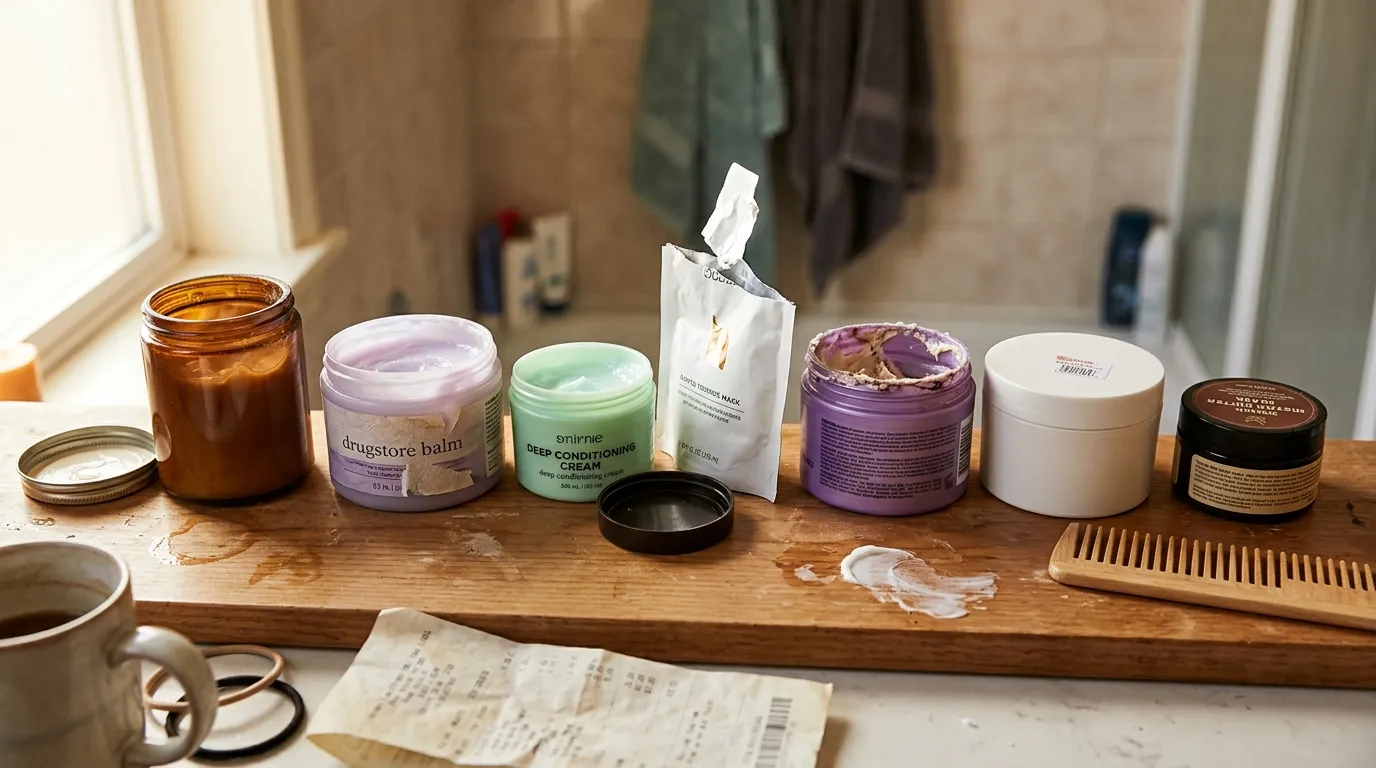
By September my shower shelf held five hair mask tubs. Four were half-used. Bought in moments of Target optimism, each smelled like a different dessert, and none was fixing the actual problem: three inches of last year’s foil highlights snapping off like dry spaghetti.
The search for the best hair mask for dry damaged hair breaks on one detail the roundups never mention: damage has causes, and masks are formulated for specific ones. Protein-heavy jars earn their keep on bleached strands. Chelating masks do the work in hard-water houses. Slather a heavy butter mask on fine hair and you’ll spend the week looking like you gave up.
So I reorganized the shelf. One jar per damage cause, on the schedule that cause actually needs, until the jar was empty. Seven jars, two months.
The Seven Jars, One for Every Damage Cause
For bleach damage: Briogeo Don’t Despair, Repair! Deep Conditioning Mask, about $39 at Sephora or Ulta. The one jar I finished and rebought. On my foil-highlighted ends it turned straw back into something a comb passes through, and it skips the heavy coconut-butter weight that flattens day-two hair. The deal I made with the price: twice a week while the bleach damage is fresh, then drop to the budget pick below.
For heat-fried hair: L’Oréal Paris Elvive Total Repair 5 Damage-Erasing Balm, about $10 at any drugstore. This one surprised me. Almond oil plus protein, thick enough to feel like a real treatment, and after a month of weekly use my ends stopped snagging on the claw clip. If your damage came from the blow dryer more than the salon, start here before you spend a dollar more.
For postpartum shedding: Mielle Organics Babassu Oil & Mint Deep Conditioner, about $13 at Target. Straight talk first: a mask can’t stop postpartum shedding, because the shed is hormonal. What this one did was keep the fragile new growth at my hairline from snapping off in the brush, which matters when every strand counts. The mint tingle feels like something is happening, and the protein-moisture balance suits a head that’s losing hair and growing it at the same time. For the bigger picture, the postpartum hair loss timeline explains why the shed peaks and when it stops.
For hard-water hair: Malibu C Hard Water Wellness Mask, about $17 online. A chelator, a different animal from the moisturizing jars. Our shower leaves mineral film on the glass, and that same film was sitting on my hair, dulling it and squeaking no matter what I conditioned with. A study in the International Journal of Trichology measured a significant drop in hair strength after months of regular hard-water soaks, compared with deionized water (Luqman et al., 2018). This mask cut the squeak in two washes. It tingles, the directions matter, and it’s a rotation player rather than a forever jar. The permanent fix was the $40 inline filter on the showerhead; the full shower filter install covers that project.
For fine hair: Verb Ghost Weightless Hair Mask, about $16 at Ulta. A hair mask for fine hair is usually an exercise in disappointment, and this is the exception. Water-light, detangles on contact, rinses clean enough to skip the ponytail rescue. Fine, low-porosity strands only tolerate so much product, so this one goes on every other week, ends only. On coarse hair it would be a waste of money.
For color-treated hair that isn’t fried: Olaplex No. 8 Bond Intense Moisture Mask, about $30. The smallest jar here at the second-highest price, and it earns it for one specific reader: single-process color, ends that are dry but still attached. It adds body while it conditions, and the little tub ran about six weekly uses, which I resent and will repeat.
The one that didn’t work for me: SheaMoisture Manuka Honey & Mafura Oil Intensive Hydration Masque, about $13. Honest verdict, because a roundup that only praises is an ad. On my hair this is a butter brick. It’s built for thick, coarse, chronically dry hair, a real audience, but on my medium-fine strands it took two shampoos to remove. If your hair drinks oil and asks for more, this is your jar. If it doesn’t, skip it.
Hair Mask vs Deep Conditioner: What the Stylists Said
I used to file them under the same product. Stylist Raven Hurtado drew the line for Byrdie in one sentence: a mask works reparative ingredients deep into the hair shaft, while a deep conditioner is a thinner formula that coats the outer layer (Byrdie). L’Oréal’s own guidance runs the same direction: deep conditioner for regular use, masks for serious recovery (L’Oréal Paris).
The translation: while your hair is genuinely fried, the mask replaces your conditioner on wash day. Once it recovers, drop the mask to maintenance frequency and let the deep conditioner become the weekly habit again. Doing both in one shower, every shower, is how $30 jars disappear in three weeks.
How Often Should You Use a Hair Mask: The Chart
Frequency depends on hair type, and the ranges are real, invented by brands long before me: L’Oréal puts fine or low-porosity hair at one mask every two weeks while bleached or curly hair benefits from two or three sessions a week (L’Oréal Paris). Here’s what I settled on after two months of counting.
| Your hair | How often | Leave it on |
|---|---|---|
| Bleached or fried | 2-3 washes a week, dropping to 1 as it recovers | 10-15 min |
| Heat-styled most days | Once a week | 5-10 min |
| Color-treated, otherwise healthy | Once a week | 10 min |
| Fine or low-porosity | Every other week, ends only | 5 min |
| Postpartum shedding | Once a week | 5-10 min |
| Hard-water house | Chelating mask weekly for a month, then monthly | Per the label |
Two adjustments the chart can’t show. If hair starts feeling limp or gummy, you’ve overshot; protein-heavy masks especially can tip fine hair past stiff into breaking, so cut back before you quit. And the application rules hold whatever the schedule: damp hair, mid-lengths to ends, combed through, rinsed cool after the label’s window, which runs five to fifteen minutes for most jars (L’Oréal Paris).
The Rules That Make Any Jar Work Better
- Towel-dry first so the mask sticks instead of sliding off.
- Mid-lengths and ends get the product. Your roots are already fed by your scalp.
- Comb it through with a wide-tooth comb so every strand gets a coat.
- Cool rinse at the end: warm water washes, cool water seals.
- The unglamorous one: cut the heat while you repair. Dermatologists recommend letting hair air dry when possible and keeping hot tools to once a week or less, at the lowest setting that works (AAD). A mask twice a week against a flat iron five times a week is a fight the mask loses.
The Winner, and the One I’d Buy Second
For bleach damage and general fried ends: the Briogeo, $39, the jar I emptied and rebought. For everyone else: the $10 L’Oréal balm, which did most of the work at a quarter of the price. Fine hair gets the Verb Ghost. Hard-water houses get the Malibu C in rotation, plus the filter.
One rule from this experiment outlasts the products: buy one jar that matches your actual damage, use it on the schedule above until it’s empty, and only then read another list. When the seasons turn and your hair changes on you, the seasonal hair care rotation is the next habit worth stealing.