Shower Filter for Hard Water Hair: 30-Day Verdict
A trichology study soaked hair in water carrying 212.5 ppm of calcium carbonate, far past the 180 ppm line where water officially counts as very hard, ten minutes at a time for 30 days. Then researchers clamped the strands in a machine that measures how much force it takes to snap them. The hard-water hair measured the same strength and stretch as hair washed in distilled water, and if anything ran nominally tougher, a difference the statistics shrugged off (International Journal of Trichology). The minerals don’t weaken hair directly. Something else in the shower does.
Because hair is only one thing in there. The same water carries soap-scum-forming calcium, a degreasing dose of chlorine, and whatever disinfectant your city pipes in. My breaking point was two weeks of a scalp that itched by 9 p.m. and a preschooler whose arms flared after every bath, in a house whose water report says “hard” without embarrassment. What follows is the rundown I wish I’d had before buying anything: what the minerals and the chlorine each do, what KDF, vitamin C, and carbon filters actually remove, how to read your water report in five minutes, and what changed in my own shower over 30 days, scored honestly.
Hard Water Hair Damage: What the Research Actually Shows
Hard water is water with a lot of dissolved calcium and magnesium. The USGS grades it by milligrams of calcium carbonate per liter: 0 to 60 is soft, 61 to 120 moderately hard, 121 to 180 hard, and anything over 180 is very hard. Your own number matters more than the map, and I’ll show you where to find it.
The hair story starts with soap. Calcium latches onto soap and turns it into the sticky scum ring around your tub, which is why the USGS notes that hard water users need more soap to get anything clean, “be it your hands, hair, or your laundry.” On hair, that scum reads as film: stiff ends, no shine, flat roots by 3 p.m. On the scalp it combines with oil and product into the kind of hard water and scalp buildup that my weekly scalp routine exists to strip. Prevention beats exfoliation, which is how water quality ended up on a beauty site.
The honest part about the hair itself: minerals alone don’t snap it. That 2013 study found no significant difference in tensile strength or elasticity, while its own authors caution that higher salt levels or longer exposure could change the result. So hard water mostly wrecks hair sideways. The film makes you scrub harder, add more heat to claw back volume, and dread wash day, while the buildup makes day-two hair look worse, which tempts you to wash less and stack more dry shampoo. My wash frequency guide covers that trap.
Skin has the better-documented case. A King’s College London-led systematic review and meta-analysis pooled 11 studies with more than 53,000 participants and found living in a hard water area was significantly associated with eczema. A UK study of 1,303 three-month-olds sharpened the picture: each 100 mg/L rise in water calcium carbonate came with roughly 5% higher eczema risk and 11% higher risk of measurable skin barrier damage, worst in babies who also carried a filaggrin gene mutation (Journal of Allergy and Clinical Immunology). Association isn’t causation, but the mechanism is plausible: minerals deposit on skin, and cleanser residue clings where minerals sit.
Then there’s the chlorine your city adds on purpose, usually around 1 part per million. In a glass, invisible. In a hot, steamy shower, it reads as public pool, and the smell is information: chlorine strips oil from skin and hair, and the byproducts it forms in pipes are regulated right up to the EPA’s legal cap of 80 parts per billion.
Does a Shower Filter Help Hair, or Just the Marketing?
Start with the boring answer: no cartridge that screws onto a shower arm genuinely softens water. Removing dissolved calcium at shower volume takes ion exchange, which is a whole-house softener and a different budget. Boxes promising “hardness removal” in a $40 filter are selling the exception as the rule.
What a good filter does measurably is strip chlorine, and on some media, chloramine, the disinfectant more than half of the largest US water systems use. That’s the piece that dries skin, frazzles color-treated hair, and fills a steamy bathroom with pool smell. The only independent standard for shower filters, NSF/ANSI 177, certifies one claim: a minimum 50% reduction of free chlorine across the cartridge’s rated life. It says nothing about hardness, chloramine, lead, or softer hair, which is exactly why those words can ride along on the same box.
So, does a shower filter help hair? If the complaint is dryness, itch, or the pool smell: plausibly yes, and it’s the one filter claim with independent testing behind it. If the complaint is stiff, limescale-flat hair in genuinely hard water: the filter helps at the edges, and a monthly chelating shampoo does more per dollar. KDF media, the copper-zinc granules inside most mid-price filters, is the one family that also claims partial scale control through a redox reaction (Kymera, which makes it). Partial is the operative word.
KDF, Vitamin C, Carbon, or Calcium Sulfite: What Each Media Removes
| Filter media | What it removes | The catch |
|---|---|---|
| KDF-55 (copper-zinc) | Free chlorine, some heavy metals; inhibits bacteria and scale; holds up in hot water | Weak on chloramine alone; needs contact time |
| Vitamin C (ascorbic acid) | Neutralizes chlorine and chloramine on contact, even hot | Consumes itself; cartridges often die in 2 to 3 months |
| Activated carbon | Chlorine, organics, odor | Least effective in hot water; weak on chloramine unless catalytic |
| Calcium sulfite | Fast chlorine knockdown in hot water | A helper media, rarely the whole answer |
The chemistry is real on all four. USDA Forest Service engineers have used vitamin C dechlorination for years because ascorbic acid neutralizes both chlorine and chloramine instantly and safely. That same appetite is why cheap vitamin C cartridges die young. KDF-55 works by redox reaction, tolerates heat, and doubles as a bacteria inhibitor. Carbon handles odor and organic gunk. The best-reviewed filters stack several of these in one cartridge.
Data is scarcer than the marketing implies. When WIRED tested the category with lab-grade colorimeters, most manufacturers wouldn’t share results. The ones that did: an inline filter NSF-certified to remove 87% of free chlorine across 10,000 gallons, and a KDF-55 plus calcium sulfite showerhead whose published lab test kept chlorine removal above 90% for three months of daily showers. Cartridges run $25 to $45 every three months. Add that to the sticker, because that’s the real price.
One variable most lists skip: your city’s disinfectant. New York and Chicago use plain chlorine; Los Angeles, Philadelphia, and Boston use chloramine, which is stabler and harder to filter (WIRED’s city-by-city list). A filter that shines in one city can disappoint in another. Check yours before buying anything.
Read Your Water Report Before Spending a Dollar
Every community water supplier in the country must publish an annual Consumer Confidence Report, due July 1 (EPA). Search your city’s name plus “water quality report” and open the PDF. Two lines matter: hardness, listed as calcium carbonate in mg/L (the same as ppm), and the disinfectant, listed as chlorine or chloramine. Hold the number against the USGS scale: above 121 explains the tub ring, and above 180 is where the filter math starts working.
On a well? There’s no report for you. A $15 hardness test strip from the hardware store reads the same units.
Then match symptoms to numbers, because winter dry air mimics hard water. White crust on the showerhead, spotted glasses, a scum ring, itchy skin that flares after showers rather than during: that’s minerals. Tight, flaky skin that peaks in January is dry air, and my winter skincare guide covers that version.
The 30-Day Verdict, and What I’d Buy
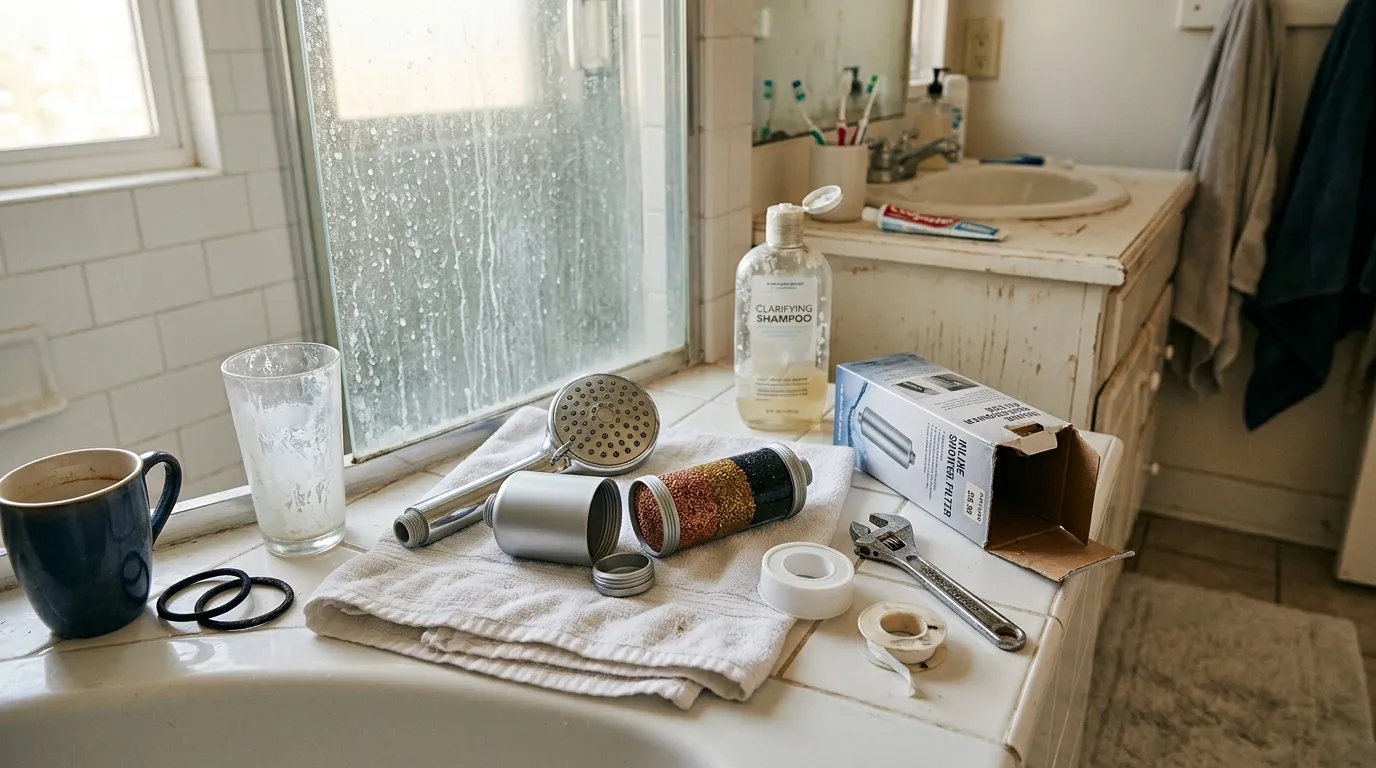
My setup: water at the top of the hard band, chloramine-treated, two adults, two shower-taking kids. I installed an inline KDF-55 and carbon filter, $90 and NSF-certified for chlorine, ahead of our existing showerhead, then scored four things for 30 days: evening scalp itch, how much shampoo it took to get a real lather, the squeak test on skin after towel-dry, and my daughter’s arm patches.
- Shampoo math changed first. By week two, noticeably less shampoo for the same lather. That’s the scum mechanism losing.
- Skin improved second. The tight, itchy-by-evening feeling faded to occasional. Quieter, not cured.
- Hair improved last and least. Softer ends by week three, but the monthly chelating wash stayed on the calendar. The filter cut the film; dissolved minerals stay dissolved.
- The kid was inconclusive. Her patches followed the weather more than the filter, so I’m calling that one a draw.
Cost check: $90 upfront plus about $30 a quarter lands near $210 a year. A chelating shampoo costs less and handles the hair half. Neither replaces the other, and the pair costs less than one box of miracle claims.
If I were starting over, here’s the order:
- Read the water report tonight. It’s free, and it decides everything after it.
- Above 180 ppm and itchy? Add an inline NSF-certified filter if your city uses chlorine, about $90 plus cartridges. If it uses chloramine, pick a KDF-55, calcium sulfite, and carbon showerhead in the $99 to $150 range; that combination tested best against chloramine. It’s also the best shower filter for skin complaints, because it strips the drying disinfectant from the biggest surface you own.
- Keep a monthly chelating shampoo. It’s the only thing that removes the minerals a cartridge can’t.
- Skip any box claiming to soften water, and the $600 smart showerheads. If limescale is also wrecking your appliances, the real fix is a whole-house softener, priced like one.
And replace cartridges on schedule. A dead filter filters nothing; it’s just shower jewelry.