How to Fix Dry Cracked Hands From Constant Handwashing
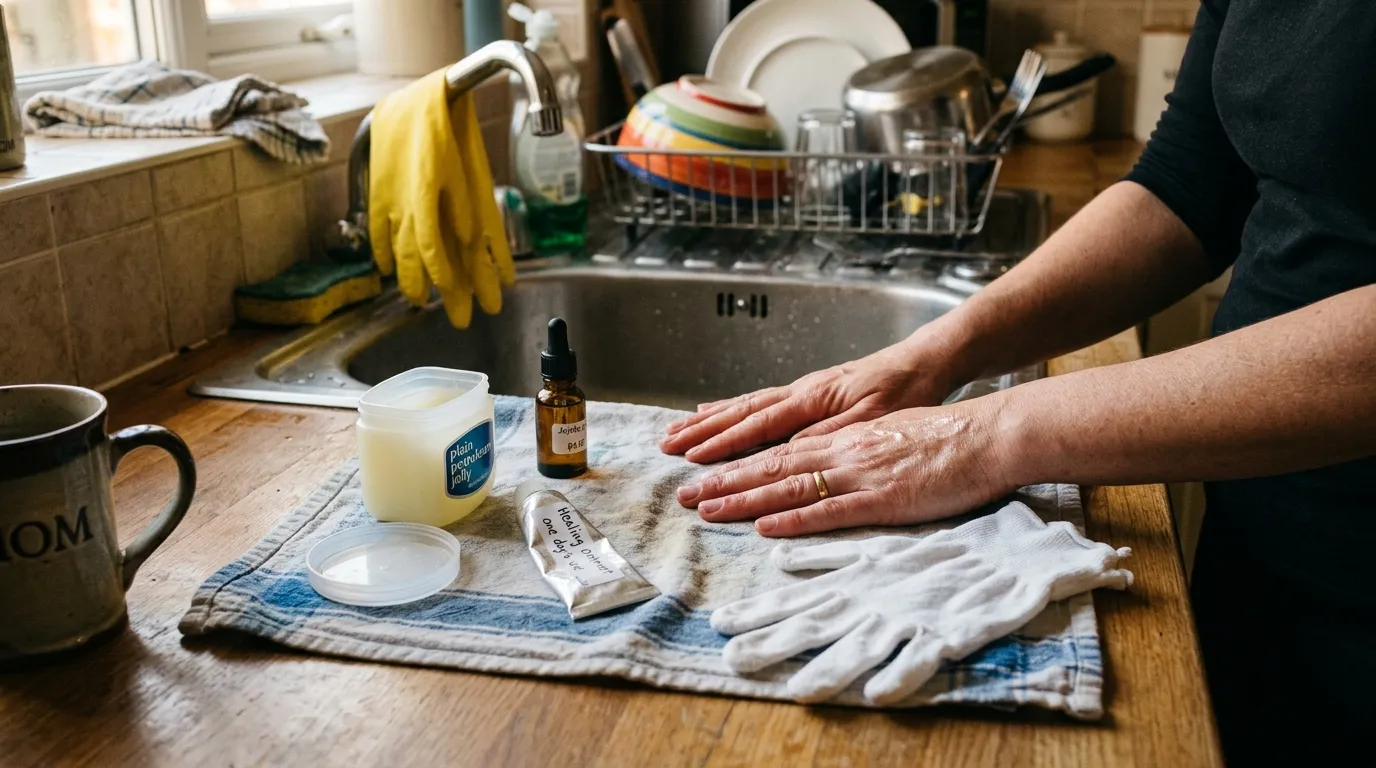
I own six hand creams and a month ago every one of them was failing me. One lived by the kitchen sink, one in the diaper bag, one in the car cupholder, and I applied them faithfully after every wash like the internet instructed. My knuckles still split open by Thursday. The problem turned out to be timing, and one line from the occupational dermatology literature fixed what six products couldn’t.
If your hands are cracked and peeling at the cuticles from constant washing, dishes, and sanitizer, here’s how to fix dry cracked hands for real: treat the washing as the injury, get cream on inside the three-minute window after every wash, and seal the repair in overnight with cotton gloves. The whole setup costs about $20 and nothing in it takes longer than 60 seconds.
Dishpan Hands Is an Injury, and You Qualify
Your grandmother had a name for this: dishpan hands. Occupational dermatology calls it wet work, and the formal definition is hands in water or waterproof gloves for 2 or more hours a day, or hand washing 20 or more times a day (Scandinavian Journal of Work, Environment & Health). Nurses, hair stylists, and plumbers carry the highest rates of hand eczema, and the American Academy of Dermatology points out that even plain water irritates skin when hands are wet often enough.
Here’s the number that reframed my sink. In a Danish study of 17,205 patients, the odds of hand eczema doubled for women after just 39 minutes of wet hands per day; at two hours, the odds ratio hit 3.49 (Lund et al., 2020).
Count your Tuesday. Two dish sessions, one bath, wipes, snack cleanup, post-playground washing, sanitizer at the store. You passed 39 minutes before naptime. Your hands log a full injury shift every day, so the fix has to work with the washing schedule.
The 60-Second Post-Wash Habit That Beats Everything Else
Dermatologists’ top tip for dry skin is to moisturize after every hand wash, and the National Eczema Association’s soak-and-seal protocol supplies the deadline: moisturizer goes on within three minutes of water, on skin that’s still damp (NEA, AAD).
Water is the delivery system. Pat your hands with the towel until they stop dripping but still feel cool and damp, then cream, then you’re done. Sixty seconds, every time you wash. Missed the window? Reapply anyway; the habit matters more than the timestamp.
Keep the tub at the sink you use most. A cream in the bathroom closet is a cream that doesn’t get applied.
Best Hand Cream for Cracked Hands: Ingredients Beat Price
The AAD’s effective-ingredient list for dry skin is: petrolatum, glycerin, dimethicone, lanolin, shea butter, jojoba oil, hyaluronic acid, lactic acid, and mineral oil (AAD). Ointments and creams beat lotions, because lotion is mostly water and evaporates off before it does much. One label trap: “fragrance-free” is what you want, since “unscented” products can still contain masking chemicals that irritate already-dry skin (AAD).
| Product | Typical price | Why it earns the sink spot |
|---|---|---|
| Plain petroleum jelly (any tub) | about $3 | Petrolatum, the most proven occlusive there is |
| Aquaphor Healing Ointment | about $6 for the small tube | Petrolatum plus lanolin, squeezes onto damp hands cleanly |
| CeraVe Healing Ointment | about $10 | Petrolatum with ceramides, less shine than the jelly |
| O’Keeffe’s Working Hands | about $8 | A cream that survives actual dish rotation |
The skip list matters too. On cracked skin, the AAD says stop products containing fragrance, alcohol, and retinoids (hand sanitizer excepted), and skip the anti-itch creams until a dermatologist weighs in (AAD).
The Peeling Cuticles Remedy: Oil the Seam, Skip the Nippers
The skin seam at the base of each nail is the thinnest part of the whole barrier, which is why it peels first and snags on everything. The remedy is unglamorous: jojoba oil, about $9 at Target, massaged along the cuticle line after every wash and again before bed. Oil soaks into that seam where thick cream mostly sits on top.
Don’t trim living cuticle, and clip hangnails flush with a clipper instead of teeth or a tug. Too much water is a direct cause of splitting skin around the nails, so the gloves below do double duty here (AAD). For the nail plates underneath all this skin, the six-week recovery plan after gel or dip covers the full protocol; the seam heals much faster than the plate.
The Overnight Hand Treatment: Cotton Gloves and Eight Hours of Occlusion
This is the NEA’s soak-and-seal method translated for hands. Lukewarm water for five to ten minutes (a bath counts). Pat to damp. Thick layer of ointment on within three minutes. Cotton gloves over everything. Sleep (NEA).
The gloves run about $7 for a three-pack at any drugstore, and their whole job is keeping the ointment on your skin and off your pillowcase. Do it two or three nights running during a bad stretch, then drop back to the daytime habit. For a truly angry flare, the NEA’s wet-wrap version adds a damp cotton layer under the dry one; that’s the escalation, not the default.
Daytime gloves come with one catch worth knowing. Rubber gloves for dishes are the AAD’s own recommendation (AAD). But the wet-work studies count long stretches in waterproof gloves as exposure too, so for the 20-minute sink, glove up; for an all-day cleaning project, wear a thin cotton pair inside the rubber ones and take them off between tasks.
And the sanitizer. Alcohol gel is part of the injury load. Where you have a choice, wash with a gentle cleanser and run the 60-second habit; save the gel for the pickup line.
When Cracked Hands Need a Dermatologist
The AAD draws the line clearly: deep painful cracks, bleeding or weeping skin, itchy blisters, or a moisturizer used all day that changes nothing. That’s hand eczema, it takes more than a good cream to clear, and dermatologists typically add a barrier repair cream or a short course of cortisone (AAD).
If your hands only do this in January, that’s the seasonal version of the same barrier problem, and the winter skin survival guide covers the house-wide fixes like humidifiers. If your whole routine needs rebuilding around five minutes instead, the five-minute skincare routine runs on the same three-minute rule; skin seals in moisture the same way at the wrists as it does at the hairline.
If you only change one thing this week, move the cream to the damp window. The three minutes after water is when the hand cream you already own actually works, and starting tonight costs nothing.