How to Remove Halloween Face Paint Without Tears
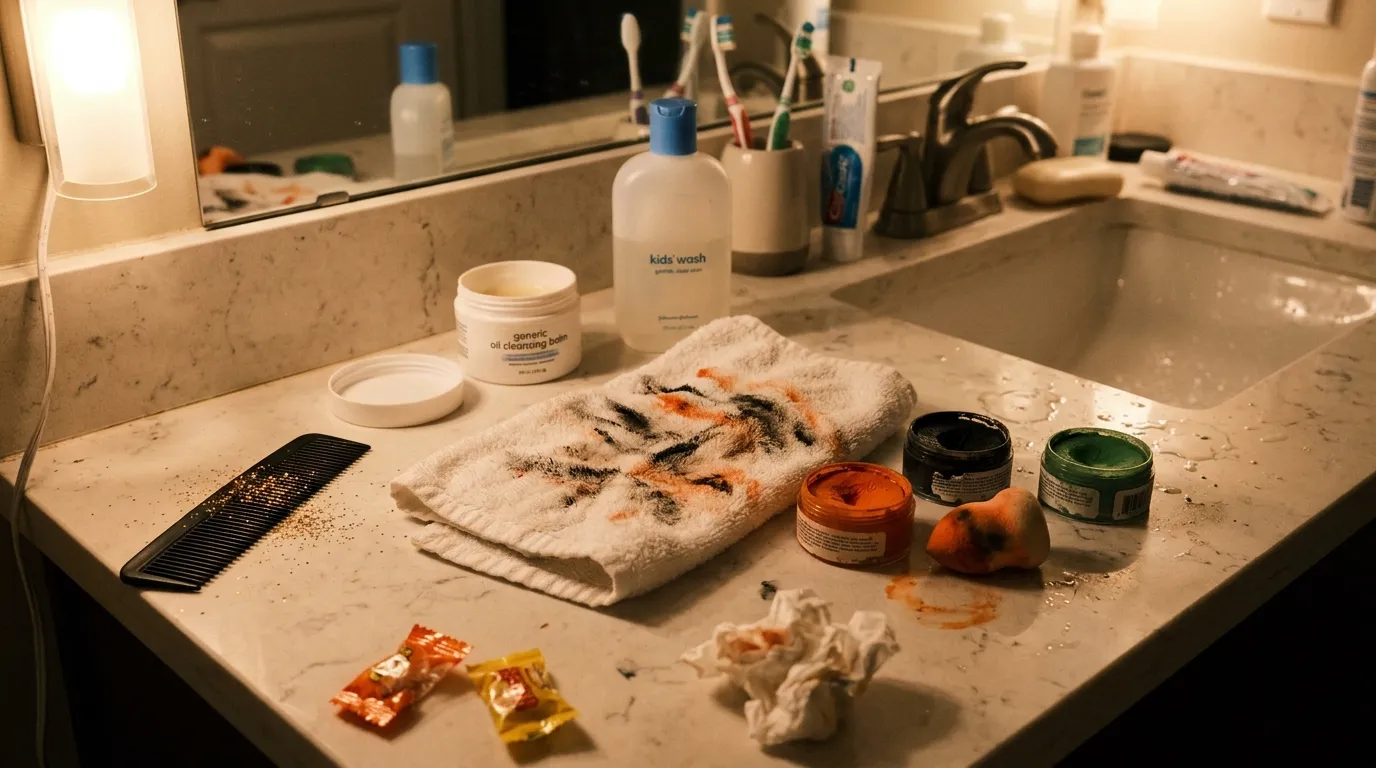
Last Halloween I removed a skeleton’s face with baby wipes and guilt. Seven wipes, one escalating negotiation, a kid whose eyes flushed pink from the fumes, and the paint still lived on in gray patches at bedtime. The failure wasn’t effort. I was using the wrong tool, the way you’d use a dry paper towel on spackle. This year I tested the routine I should have started with, timed it at about 90 seconds including complaining, and maybe my kids are hardened now, but there were zero tears. If you’re reading this at 8 p.m. with a zebra standing in your bathroom, here’s how to remove Halloween face paint tonight: two steps, one washcloth, no scrubbing.
The 90-second, two-step sink routine
The problem with face paint is the pigment load. Even water-based paints are packed with color, and the manufacturers know it: Snazaroo’s FAQ admits some dark shades are stubborn on certain skin and specifically warns parents to stop if skin gets irritated from scrubbing (Snazaroo). The FDA’s guidance for novelty makeup is just as direct: remove it the way the label says, be gentle around the eyes, and never sleep in it (FDA).
Step one: oil, before any water. Massage a cleansing balm, baby oil, coconut oil, or the emergency Crisco in your pantry over the paint with your fingertips. Coating pressure about equal to pressing a Post-it note, 45 seconds. Skip soap; the point is that the oil grabs the pigment and binders without any friction at all. A 13-ounce jar of cleansing balm runs $9 to $14, plain mineral baby oil is about $3, and either will outlast several Halloweens.
Step two: a real wash. Now lukewarm water and a gentle cleanser on a soft washcloth, light passes, then pat dry and put moisturizer on. Any pigment that survives step one usually gives up here. Whatever still shows after that is staining, which the FDA says fades on its own; repainting over it later in the week is not the move.
One eye rule for the whole routine: closed eyes, strokes moving outward, never in. And if the look involved neon or fluorescent colors, keep everything away from the eye area entirely. The FDA approves eight fluorescent colors for cosmetics, and none are allowed near the eyes (FDA). Let the shower handle that zone tomorrow.
Why makeup wipes sting on kids face paint sensitive skin
The wipes feel like the obvious tool because they’re pre-moistened and marketed for faces. Two problems, and both are on you by 8 p.m.
First, they can’t actually cut the paint. A wipe glides pigment around on wax-based paint, so you press harder, go back over the same cheek five times, and turn friction into the main ingredient. That alone leaves kids raw and pink.
Second, the wipe itself carries chemistry. In 2014, pediatricians reported six children who developed allergic contact dermatitis from methylisothiazolinone, a preservative in wet wipes (Pediatrics), and European regulators went on to restrict that same preservative to rinse-off products because of its reaction record (Australas J Dermatol). Preservative formulas change, but the category hasn’t: a damp, fragranced, preserved towelette dragged repeatedly across kid skin and around eyes is a chemistry problem and a friction problem at once. Contact dermatitis is common enough that dermatologists describe more than 15,000 substances capable of triggering it, with fragrance among the most frequent offenders, and the rash often shows up hours to days after exposure (AAD), which is why a Tuesday rash gets blamed on everything except Saturday’s wipe.
If wipes are truly all you have tonight, wet a washcloth with warm water and your kid’s gentle cleanser instead, and work in small dabs rather than swipes.
Glitter face paint removal: the don’t-scrub plan
Glitter has a different problem than paint. Usually it’s cosmetic glitter suspended in a gel glue base, which behaves a lot like the cream products I break down before school picture day makeup: the oil stage dissolves the gel, the glitter releases with it.
Start dry. Press a strip of tape or a lint roller against the skin and lift; standing glitter comes off mechanically with zero rubbing. Then go back to the oil, let it sit over the glitter patch for a full minute, and sweep it off with the washcloth in one direction. Repeat once if needed.
Never scrub glitter. Dragging flakes across skin can leave micro-scratches, and around eyes it’s a hard no, not tonight and not ever. Ask the face painter what they used while the paint is still on; if it was glitter glue, the label’s removal instructions apply, and the FDA’s reminder holds even for approved pigments: too much of a good thing irritates delicate skin (FDA).
If your kid has eczema, three swaps before street time
Eczema shows up early and often, typically between 2 months and 5 years (AAD), so plenty of Halloween-cheeked kids are working with a compromised barrier. Swap accordingly.
- Skip scented anything: fragrance-free balm, fragrance-free cleanser, no wipes on the face at all.
- Ask the face painter for a thin white base coat under the color; the paint maker’s own fix for staining on sensitive skin applies double for eczema (Snazaroo).
- Patch-test any new paint on the inside of the forearm a couple of days before Halloween, FDA-sanctioned homework (FDA). For under-3s, a small cheek motif beats a full face.
- Moisturize the moment the paint is off. For kids who watch what you do to your own face, these same habits scale; teaching kids self-care without the Sephora obsession is the long-game version.
When post-Halloween redness needs watching
Same-night pinkness that’s flat and slightly dry over painted areas is usually simple irritation: warm washcloth, fragrance-free cream, clearer within a day or two. What earns a call to the dermatologist is different. Itching fierce enough to wake them, raised or blistered patches, swelling, anything spreading past the paint lines, or a rash that’s still going strong after three or four days. The FDA has recalled face paints before, in 2005 and 2009, for rashes, irritation, itching, and swelling, and it tracks consumer reports of bad reactions (FDA). A reaction worth logging is one the agency wants to hear about.
If you only do one thing tonight, put oil on before the paint gets an overnight head start, then wash and moisturize. And when the paint is finally gone, take a phone photo of whatever redness remains, dated. If Tuesday still looks like Saturday, you’ll have the receipts.