Brittle Nails in Winter: Why It Happens and What Helps
Search interest in brittle nails runs 43.4 index points higher in Northern Hemisphere winters than in spring, according to a 2026 Google Trends analysis in Acta Dermato-Venereologica. In the seasonal model, humidity was a significant factor. Temperature was not. That is a useful clue for anyone whose nails turn into a snagging, peeling mess around the first frost: the problem is seasonal, environmental, and carried by water.
Your hands go from hot dishwater to a cold car door to hand sanitizer to a toddler’s bath, then back. Do that fifty times a day for three months and the free edge starts to delaminate in thin horizontal layers. Four weeks will not regrow a nail. It will stop the active damage and put about 3.2 mm of clean new plate at the base.
Why do my nails break in winter? Start with water
The nail plate is dead keratin. It can hold water, and how much it holds depends on the air around it. In a lab study that stored nail clippings at different relative humidities, the nails held between 14% and 30% water across 55% to 80% relative humidity, and their resistance to tearing peaked at 55%. Nails were brittle when fully dry and split when wet (Farran et al., Journal of Experimental Biology).
The target is the moderate zone, and winter pushes hands to both extremes: dry furnace air and hot soapy water. The EPA recommends keeping indoor humidity between 30% and 50%, and a heated house in February often sits below that (EPA).
Here is where the usual advice gets shaky. A 2007 study of 102 people found no significant difference in water content between brittle and normal nails: 12.48% versus 11.90% (Stern et al., Journal of the American Academy of Dermatology). The samples lost water after clipping, so the numbers are imperfect. Brittle nails are not simply dried-out nails.
The wet-dry cycle has a name. Lamellar onychoschizia is horizontal splitting at the free edge, and it is typical of people who wash their hands constantly, including homemakers, nurses, and doctors (Chessa et al., Dermatology and Therapy). Moms qualify. Water gets between the nail cells. They swell, then dry and shrink. The bonds at the edge fatigue. A nail that was fine in October starts peeling in January.
Peeling nails cold weather: the horizontal split, explained
Most winter peeling is onychoschizia. The damage starts at the free edge and peels back in thin horizontal layers, like a stack of paper that got wet. It usually affects several fingers and gets worse after a day of cleaning.
Onychorrhexis looks different. Vertical ridges and splits that run the length of the nail point toward the matrix, aging, or a systemic issue, and they deserve a closer look if they are new or worsening (same review).
Then there is the gel and dip variable. If your nails were strong until a soak-off set came off, the cause is mechanical thinning and acetone. Our six-week recovery plan for gel and dip damage covers that sequence. This plan is for nails that were fine last summer and started peeling when the heat came on.
How to strengthen brittle nails without buying the whole aisle
The nail plate cannot be repaired from the outside, which is why the strengthening aisle is mostly theater. A coating can protect the surface. It cannot rebuild a dead plate. The moves that matter are boring, cheap, and repetitive.
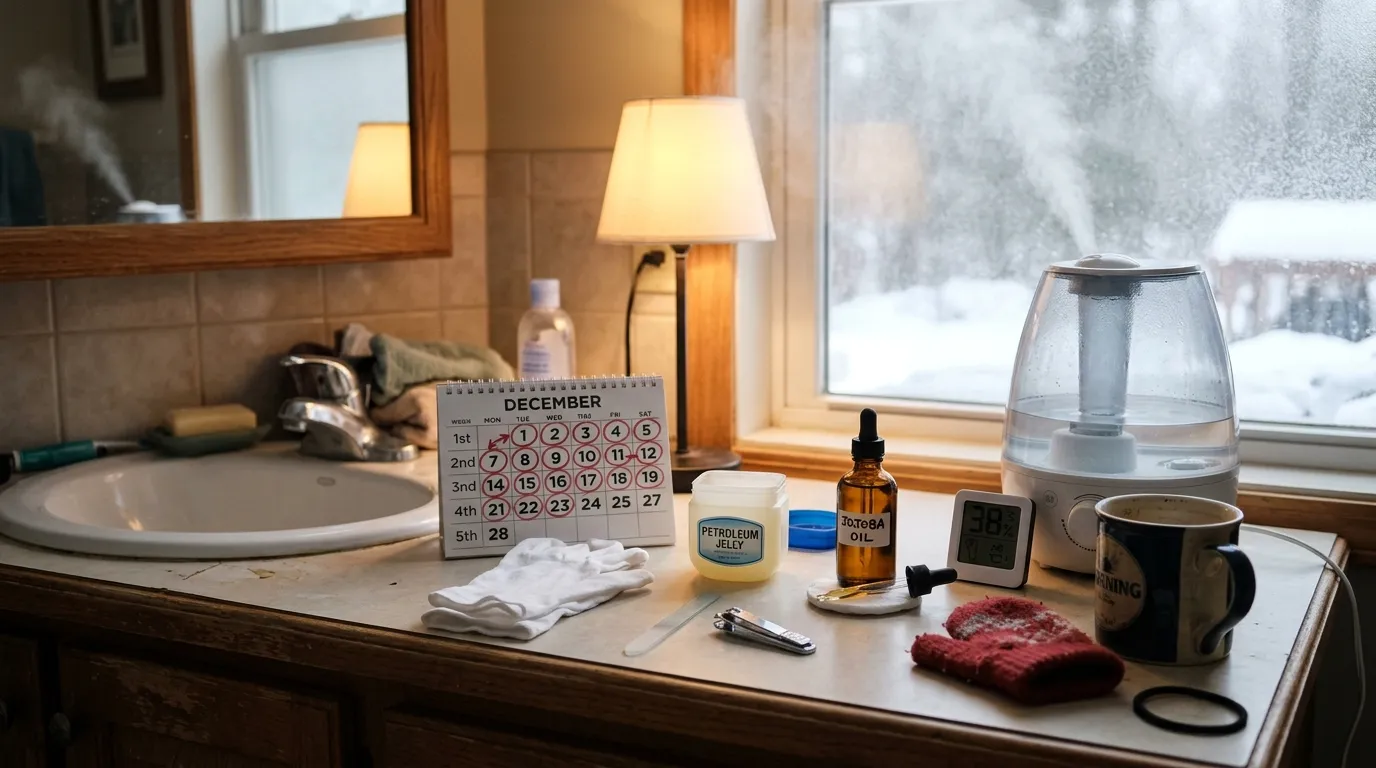
Oil is the one product worth keeping by the sink. Jojoba runs about $9; petroleum jelly, about $3. The AAD recommends applying petroleum jelly to nails and cuticles several times daily between polish sessions (AAD). Massage it into the plate and the nail fold. The plate is where water leaves; the fold is where the seal lives.
Cuticle cutting is a net loss. The cuticle is the gasket between plate and skin. The AAD tells people not to remove it, and its gel-manicure guidance says to refuse a manicurist who wants to push or cut it (AAD). A dry cuticle can crack on its own, and picking or trimming it opens a path for water and bacteria.
Gloves are the whole ballgame. The AAD names too much water as a cause of splitting, peeling, and breaking, and recommends gloves for dishes and cleaning plus moisturizer after hand washing (same page). A $4 pair of rubber gloves by the sink will do more than a $30 strengthener.
File in one direction and stop buffing. A glass file cuts cleanly; buffing removes thickness you cannot spare.
Supplements are the last stop. The literature centers on biotin, iron, zinc, and cysteine, and most studies are small and uncontrolled (review). Calcium is the folk remedy, but it does not show up as a lever. The Canadian Dermatology Association says the evidence for biotin is insufficient, and it can interfere with common blood tests (CDA).
Winter nail care that changes the equation
Four weeks is one nail-growth cycle, not a full regrowth. Fingernails grow about 3.47 mm per month (Yaemsiri et al., 2010), so four weeks produces roughly 3.2 mm of new plate at the base.
| Week | Focus | The moves |
|---|---|---|
| 1 | Stop the cycle | Polish off. Trim short. Gloves by every sink. Oil after each wash and before bed. Humidifier at 30% to 50%. |
| 2 | Protect the seal | Leave the cuticle alone. Use lukewarm water and gentle soap. Pat hands dry. Oil after every wash. |
| 3 | Add overnight repair | Twice this week, petroleum jelly or hand cream, then cotton gloves for bed. No polish. For an event, traditional polish over a base coat. |
| 4 | Check the math | Look for about 3 mm of smooth new plate at each base. Still peeling? Check gel or dip history, or a medical cause. |
Week three is where people cheat. An event comes up, and a gel set feels like the only option. Press-ons with adhesive tabs are the lower-risk splurge because they come off with warm water and oil instead of acetone. Our press-on guide for moms covers which sets survive school pickup.
The humidifier changes the air for eight hours while you sleep. The EPA’s target is 30% to 50% (EPA), and a $30 cool-mist unit is enough for most bedrooms. Clean it weekly. The winter skincare routine and the dry cracked hands guide apply the same logic elsewhere.
When brittle nails need a dermatologist
Four weeks of consistent care should change the direction. If it does not, or if the pattern is unusual, stop buying products and book an appointment.
Go sooner if you see pain, swelling, redness, pus, a greenish-black color, a nail lifting from the bed, a new dark streak, pitting, deep horizontal grooves, or thickening and yellowing. The AAD lists these as changes a dermatologist should examine, and a new dark streak needs a skin cancer check (AAD).
One nail affected is another reason to go. Seasonal peeling usually shows up on several fingers. Brittle nails plus hair loss, fatigue, or feeling cold is worth asking your doctor about iron and thyroid (CDA).
If you only do three things: gloves by the sink, oil after every hand wash, and bedroom humidity between 30% and 50%. Add the overnight glove treatment in week three. Skip the hardeners, the buffer, and the calcium. Four weeks buys about 3.2 mm of new nail, the only repair that ships on schedule.