How to Fix Chapped Lips in Winter (and End the Cycle)
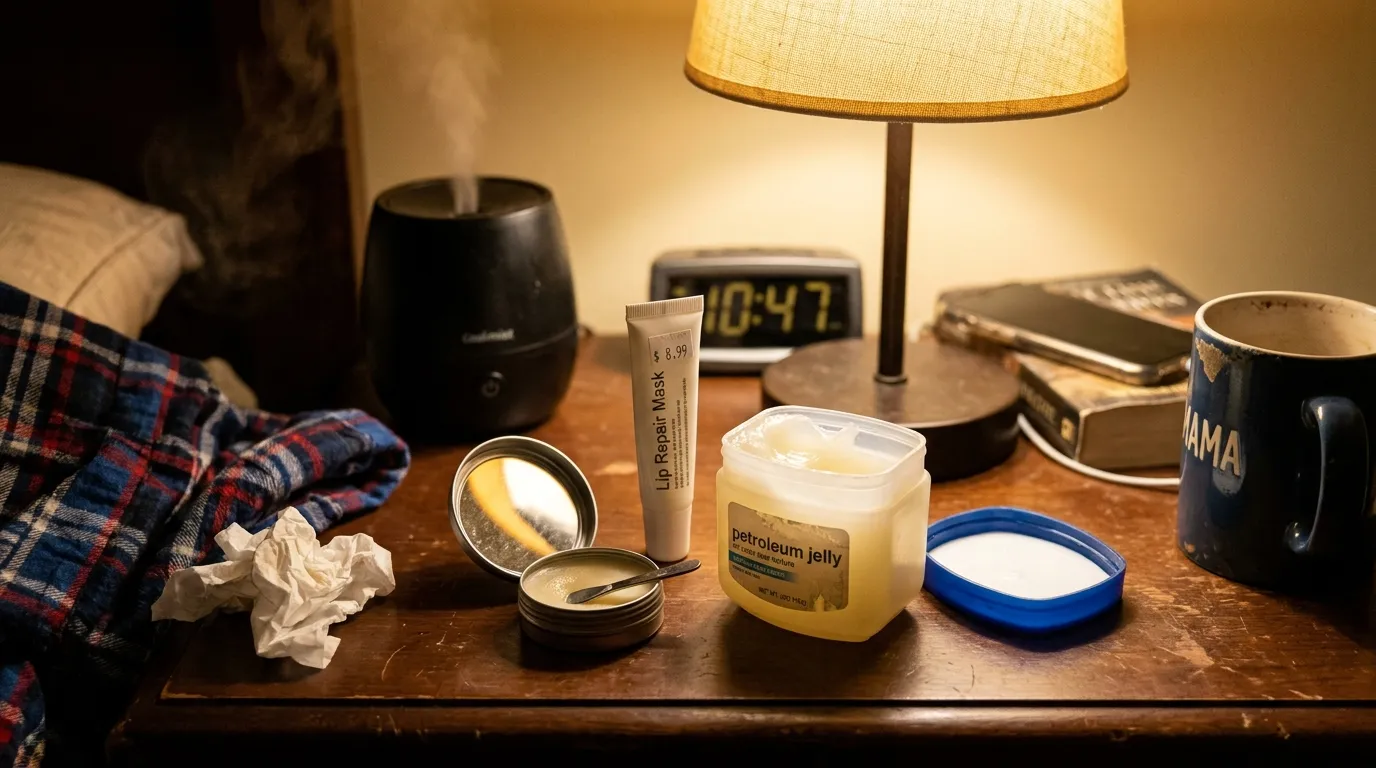
Last winter I emptied four lip balms in nine weeks and finished March with worse lips than I started September with. If that math sounds familiar, you have been working the wrong problem. Chapped lips feel like dryness, so everybody reaches for hydration, but the red part of your lips has almost no sebaceous glands and no sweat glands at all, which means it cannot oil or moisturize itself the way the rest of your face can (per a physiology review in the Journal of Cosmetic Dermatology). A new wax over a barrier that cannot repair itself just gives your tongue something fresh to lick off in forty minutes. Learning how to fix chapped lips in winter means treating the lips as an injury with three specific causes, then running a two-week repair plan built on sealing balm instead of scrubs. Diagnosis first.
Why do my lips keep cracking? The licking habit nobody logs
Every cracked lip has an accomplice, and it usually belongs to you. Dermatologists writing in the International Journal of Women’s Dermatology identify saliva as the most common single irritant in lip dermatitis, because it carries digestive enzymes that eat through the thin barrier on the lip surface. The loop is short. Dry lips feel tight. A tongue swipe fixes them for about thirty seconds. The saliva then evaporates and strips the surface oils on the way out. Lips emerge drier than before, so you lick again. By February that loop has run a few hundred cycles, and most people cannot remember a single one.
Winter stacks one more trigger on top: mouth-breathing. A stuffed nose, yours or the one you caught from a kid, means sleeping eight hours with your mouth cracked open, which dries the lip surface straight through the night and hands you a fresh licking urge by breakfast.
The habit test costs one day: keep a tally. Most chronic lickers quit counting by lunch. If your number surprises you, the cause of your chapped lips is behavioral, and the fix is redirection more than product.
The overnight culprit: retinoid migration to your lip line
If you use a retinol or a prescription retinoid, and your lips crack harder than the rest of your face does, look at your night shelf before you blame the weather. London dermatologist Sam Bunting puts it starkly: if you use a retinoid long enough, especially in winter, “you WILL experience this at some point”. The product reaches your lips by accident, a finger swiping the lip line mid-application, or your face smearing into the pillow, where it triggers dryness, itching, and outright dermatitis.
Her counters are worth copying exactly. Apply lip balm right after cleansing and before the retinoid goes anywhere near your face, and work it into the corners of the mouth where products pool overnight. Massage the retinoid in fully so no loose residue can drift while you sleep. If your lips crack mainly at the corners and the timeline matches a new retinoid, you have found a co-defendant. The starter version of this routine lives in the retinol guide for over-40 skin.
Lip licker’s dermatitis: the ring around your kid’s mouth, explained
One more ID worth knowing, because this one mostly shows up on children’s faces. Lip licker’s dermatitis is what constant licking does to the skin around the mouth: a red, scaly ring that reaches exactly as far as the tongue can travel, usually spares the corners of the mouth, and flares all winter (irritant contact cheilitis). The winter link is indirect but real, the dry air and the runny-nose season start the cycle, and the tongue keeps it going.
Treatment there is blunt: boring ointment, applied generously, and no lasting improvement until the licking stops, because every fresh coat of saliva resets the irritation (the same dermatology review covers kid cases in detail). Balm breaks the wet-dry cycle: lips that stop feeling tight give a child’s tongue a reason to retire. If months of plain ointment get nowhere on either of you, escalate to the doctor rather than to a fancier balm.
Chapped lips treatment: the 14-day repair plan, day by day
The American Academy of Dermatology gives healing a window of two to three weeks, which is why the plan runs fourteen days. The work inside it is unglamorous, and it starts with a layering change: balm first, retinoid second, every night, so the lip line gets a sealed surface under your actives.
Then the routine, organized by time of day. Overnight is the main event, because you are unlicked for eight straight hours, and ointments seal in water longer than waxes or oils, which is dermatology’s way of saying plain white petroleum jelly outperforms the trendier stick.
Morning. Rinse lips with plain water, no scrub, and press a thin layer of the boring balm on while they are still damp. You are softening flakes, not sanding them off, because softened flakes shed on their own around day four and your teeth stop finding them first.
Daytime. Reapply after every meal, coffee, and tissue run. Keep the tin in the same pocket as your phone so it gets checked as often as your notifications. And when you catch a lick happening, the AAD has a replacement rule: apply a non-irritating lip balm instead. The balm becomes the habit.
Night. The heavy act. A thick coat of petrolatum, or an overnight lip mask whose ingredient list you have actually read, worked in with one fingertip and pulled past the lip line so the corners get covered. A minute, done with the lights off.
If a split opens. Seal that spot with an extra-thick coat before bed and keep your hands off the crust. A healed crack by day nine or ten is the milestone that matters.
The best lip balm for dry lips is one you never crave
The pharmacy wall sells sensation, because menthol wind and cinnamon sting read as working. The AAD’s position is the opposite: burning, stinging, or tingling means the product is irritating your lips, so that tube goes in the trash. Their do-not-buy list covers menthol, camphor, eucalyptus, phenol, salicylic acid, fragrance, and flavor, with cinnamon, citrus, mint, and peppermint named as the worst offenders on already-dry lips. A balm that tastes like a candy cane renews the injury every hour.
So the best lip balm for dry lips turns out to be the boring one: plain petrolatum, or a fragrance-free balm built on petrolatum, shea, or ceramides. Two cautions from the patch-test literature. Lanolin, the cult-favorite healing fat in many lip masks, was named the American Contact Dermatitis Society’s Allergen of the Year for 2023; among dermatitis patients, patch-test reactions run between 1.7 and 3.3 percent, and sensitization risk climbs higher on skin that is already split. Flavorants and fragrances are repeat offenders in allergic lip dermatitis too, which is why the two-week test matters: if your lips worsen on a product, subtract the lanolin balm, keep the boring one, and see which one was the problem. At about $3 a tub, petroleum jelly is the cheapest diagnostic in the aisle.
What your bedroom air is doing to your lips all night
The furnace is the third suspect, and it works the night shift. Heating dries indoor air two ways. Warm air drops relative humidity by 10 to 20 percent just from being heated, and by deep winter plenty of homes sit near 15 to 25 percent, drier than most deserts. The EPA recommends holding indoor humidity between 30 and 50 percent, and the gauge that measures it costs a few dollars at any hardware store.
A humidifier in the bedroom is the highest-leverage item on this list, because it acts on the eight hours when no balm is being reapplied and, per the AAD, matters most for anyone who breathes through their mouth at night. Clean it weekly so it does not trade one problem for another.
Why your lip scrub belongs in the drawer
This is the step everyone runs backwards. Scrubbing a chapped lip feels like progress, flakes gone, lips smooth for an hour. But flake removal is exactly the motion that tears a split deeper, and dermatologists class picking, biting, and chewing flaked skin in the same destructive family as licking, because every flake forced off reopens the healing edge (the same review covers the picking chain too). Lips are the thinnest skin you own, and friction is not a strategy they can survive. The flakes let go on their own around day four, once the seal underneath is doing its job. No blood.
If two weeks of this does nothing, escalate
A routine is not a diagnosis. If the system holds, balm-first nights, boring balm at meals, a gauge-verified humidifier, and the cracks still come back, book an appointment. Persistent chapping can be an allergy to an ingredient you never suspected, a yeast infection, or actinic cheilitis, a precancerous change that looks like one dry, scaly lip that never quite heals (AAD). Take your current balm along so the doctor can read the label; a patch test beats another trip down the balm aisle.
Start here, in order
The playbook, ranked:
- Stop the licking. Every caught lick becomes a balm swipe. This is the main fix; everything else supports it.
- Seal nightly. A thick coat of plain petrolatum over the whole lip area at bedtime, and lip balm applied before any retinoid touches your face. The winter skincare routine for moms covers the occlusive logic for the whole face, and the dry cracked hands guide runs the same overnight-seal trick on fingers.
- Fix the air. A bedroom humidifier, aimed at 30 to 50 percent on a gauge you can actually read.
- Retire the irritant balms. Menthol and flavor out, boring balm in.
- No scrubs for two weeks. The barrier rebuilds itself the moment you stop sanding it.
Four balms got me nowhere last winter because each one was the wrong tool for the job. One boring tub, used at the right hours, in a bedroom with real humidity, repairs the barrier itself in fourteen days. Chapped lips live on a two-week clock, and the clock only starts once you stop feeding the cycle.